
Hiring a licensed electrical contractor is the single most reliable way to protect your home, your family, and your wallet when electrical work is on the table. In Rigby, where a lot of housing stock predates modern wiring standards, cutting corners here is how small jobs turn into serious problems.
Electrical work is one of the few home trades where a bad decision can burn your house down or kill someone. That sounds dramatic until you've seen what a double-tapped breaker or a missing ground looks like behind a finished wall. Idaho requires electricians to be licensed for a reason, and that requirement exists to protect you, not to make hiring harder.
At Electric Falls, we've spent over eight years working on Southeast Idaho homes, and the pattern is consistent: the expensive emergencies almost always trace back to unpermitted, unlicensed work from years earlier. A homeowner saves a few hundred dollars on an install, then pays far more later to fix the mess.
Finding licensed electrical contractors in Rigby starts with knowing where to look and what to filter out. Most homeowners waste time on the wrong sources before they ever reach a qualified pro.
The best sources are ones where licensing can be verified independently. Referrals from neighbors and local Facebook groups are a decent starting point, but they only tell you the work looked fine, not that the contractor holds a current license.
Better options include:
A common mistake is trusting a directory that lists anyone willing to pay for placement. Those listings often skip verification entirely.
Watch for these before you waste a phone call:
If a contractor dodges the licensing question, that's your answer. Move on.
The Idaho electrical contractor license lookup is a free public tool, and running a check takes about five minutes. Every homeowner should do this before signing anything.
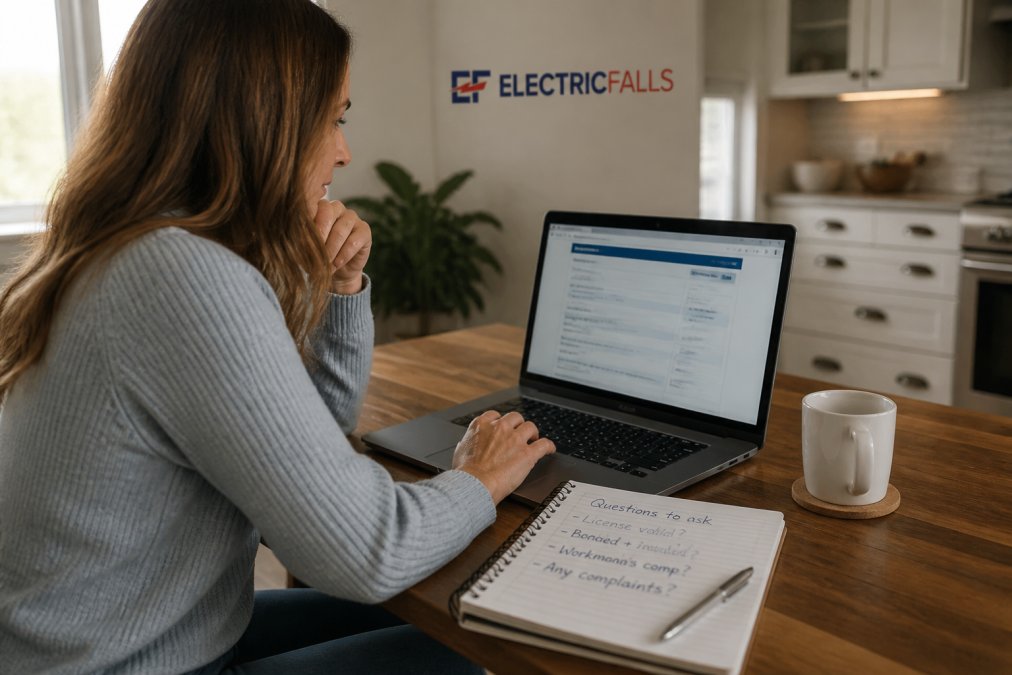
Here's how to verify a contractor through the Idaho Division of Occupational and Professional Licenses license search:
Idaho separates licenses by category, and a master electrician holds a different credential than a journeyman or an apprentice. For a project that needs permits and inspections, you want a licensed electrical contractor who can legally pull the permit and supervise the work.
What most guides miss is that a valid license doesn't guarantee the contractor is insured. Those are two separate checks, and you need both.
Hiring insured electricians for residential work means confirming two distinct policies: general liability and workers' compensation. One protects your property; the other protects you from being liable if a worker gets hurt on your job.
Ask for a certificate of insurance and then verify it. Certificates can be faked or outdated, so call the insurance agent listed on the document and confirm the policy is current. This step takes five minutes and it's the difference between a covered repair and a personal lawsuit.
Here's what each policy actually covers:
Coverage Type | What It Protects | Why You Need It |
|---|---|---|
General liability | Your home and property | Pays for damage the crew causes |
Workers' compensation | Injured workers | Shields you from medical liability |
Bonding | Your deposit and completion | Recovers losses if the job fails |
Commercial auto | Vehicles on your property | Covers damage from work trucks |
If a contractor can't produce a certificate, or the policy has lapsed, don't proceed. This isn't a technicality. It's the entire point of hiring a professional.
The questions to ask electrical contractors before hiring fall into two buckets: credentials and logistics. Get clear answers on both before any work begins.
A contractor who answers these directly is worth keeping. One who gets evasive or promises everything without detail is a risk. Get every answer in writing, including the scope and the payment schedule.
No competitor page walks you through the actual permit process, which is exactly why unpermitted work keeps surfacing during home sales. Here's how it works locally.
Permitting for work inside Rigby city limits runs through the city's building department, while projects in unincorporated Jefferson County go through the county building department. Both adopt the current National Electrical Code as the baseline, which means the inspector is checking against the same standard a licensed contractor already builds to. If you're not sure which jurisdiction your address falls under, the contractor should know, and if they don't, that's a signal.
Not every small task needs one, but the list is longer than most homeowners assume:
Swapping a light fixture or replacing a like-for-like outlet typically doesn't require a permit. Anything that touches the panel, adds load, or runs new wire usually does.
Most residential jobs follow the same rhythm:
A panel upgrade often adds a separate service inspection. Skipping the rough-in is the most common shortcut, and it's the one that causes the most expensive problems later because the wiring is already buried.
A large share of homes in the area were built before modern grounding and GFCI requirements were standard (What Changed in the 2026 NEC?). When an inspector opens a wall on a 1960s or 1970s home, they frequently find aluminum branch wiring, ungrounded outlets, or a panel that was never rated for the load it's carrying. A permit forces those issues into the open before they become an emergency.
Confirm the specifics for your address with the local building department before work begins. The National Electrical Code sets the baseline standard that local codes adopt, and it's updated on a regular cycle, which is another reason older work may no longer meet current requirements.
Not every electrician is the right fit for every job, and the mismatch usually shows up as delays, callbacks, or a bid that quietly excludes half the work. Matching the contractor to your project saves time and frustration.
A residential service call for an outlet repair is a different animal than a full rewire on a 1970s home or a generator installation. Ask directly whether the contractor handles your specific type of work, and ask for examples of completed projects.
This is the bread and butter for most local electricians: troubleshooting dead circuits, replacing outlets and switches, adding dedicated circuits, and upgrading panels. Look for someone who does this daily rather than treating it as a side job between large commercial contracts. Response time and clear communication matter more here than a long project portfolio.
Homes built before the 1980s frequently have aluminum branch wiring, two-prong ungrounded outlets, or a fuse box that was never designed for modern loads. A rewire is invasive work, walls get opened, and the schedule depends on what's behind them. Ask how the contractor handles unexpected discoveries and whether the bid accounts for patching or just the electrical scope.
Kitchens, bathrooms, and additions need someone comfortable coordinating with other trades and reading plans. Hot tubs, spas, and EV chargers each have their own circuit and grounding requirements, so confirm the contractor has installed that specific equipment before.
Generator and transfer switch installation is a specialty. A transfer switch wired incorrectly can backfeed the utility line and endanger line workers, so this is not a job for a generalist. Ask whether the contractor has completed installations with your generator brand and whether they handle the permit and inspection.
This is the project type most local guides ignore, and it's one of the fastest-growing categories in the area. Shops, barns, barndominiums, and agricultural service entrances have different load calculations, grounding requirements, and inspection expectations than a standard house. If your project involves a large outbuilding or a living space inside a shop structure, ask specifically whether the contractor has wired one before, the answer tells you a lot.
Landlords need reliability and someone who handles maintenance calls without hand-holding. Prioritize a contractor who documents work clearly, because you'll want a paper trail for tenant disputes and future sales.
The right contractor will be honest if a job is outside their wheelhouse. That honesty is worth more than a yes to everything.
Finding licensed electrical contractors in Rigby comes down to verification, not vibes. Check the license, confirm the insurance, ask the right questions, and insist on permits and inspections. Do that, and you'll avoid the expensive mistakes that plague homeowners who hire on price alone.
Electric Falls is a licensed and insured team serving Rigby, Idaho Falls, Rexburg, and Ammon with over eight years of experience. We handle residential rewiring, panel upgrades, whole-home surge protection, and generator installations, all backed by a commitment to safety and current electrical codes.
Get a quote from Electric Falls and get your project done right the first time.
Ask for the contractor's license number, then confirm it through the state's online licensing database. A legitimate licensed electrical contractor will provide this without hesitation. Check that the license is active, matches the business name on the estimate, and covers the type of work you need, whether that's residential wiring, panel upgrades, or commercial electrical. If the license is expired, suspended, or listed under a different name, walk away.
Start with three things: an active license, proof of liability insurance and workers' compensation, and a written scope of work. For residential work in older Southeast Idaho homes, ask whether they have experience with panel upgrades and wiring replacement, since knob-and-tube or aluminum wiring needs different handling than modern circuits. Also confirm they pull permits for work that requires them, and get the estimate in writing before any work begins.
Most jurisdictions require permits for panel upgrades, new circuit installations, service changes, and major remodels that involve wiring. Smaller tasks like swapping a light fixture or replacing an outlet usually do not. In Rigby and across Jefferson County, requirements follow local building department rules, so ask your contractor directly whether your specific project needs a permit. A licensed electrical contractor should already know this and include permit costs in the written estimate.
Request a certificate of insurance directly from the contractor or their insurance agent. Look for general liability coverage and workers' compensation, and confirm the policy is current. The certificate should list the business name matching the one on your contract. You can also call the insurance company listed on the certificate to verify the policy is active. Never rely on a verbal assurance that someone is insured; get the document before work starts.

What an excellent experience! I highly recommend this company! from first contact, through quoting, modifications to scope, ordering materials, installation and follow through, there was not a single minute that I didn't know exactly what was going on. The communication, product and service were all impeccable. A+

Gerry T.


Dustin came over to our house and helped us hook up a hot tub. His quote was well below others that we had come over and he was super easy to work with. I would recommend electric falls to anyone who needs a great electrician at an affordable cost!

Hailey W.
These guys are awesome. More than fair pricing, punctual and professional! Highly recommend!

Jim C.
Quick response and fixed the problem efficiently. Would use him again with any needs.

Christine P.
We had a great experience with Electric Falls. We had a need to replace an old fuse box with a breaker box. Dustin was quick to respond, was reasonable in his quote, and did exceptional work. We were pleased with his coordination with us and with Idaho Falls Power. He performed the work when he said he would do it and completed the work within the timeframe that was estimated. Overall, we are extremely satisfied with Electric Falls and will be calling on them again for future needs.

Paul M.
I can not say enough good things about these guys. They got to me so quickly, were incredibly nice, and handled my problem right away. 10/10 would recommend

Whitney P.
Dustin is everything you wish for in every small business owner! He went above and beyond right out of the gate by coming by to do my quote in the evening when he was leaving for a long weekend the next morning. He explained everything about the quote. Price was fair for work being done. He and Cameron showed up as promised and did quick, quality work. Highly recommend!

Robert N.
Dustin was professional from bid thru install of our emergency home generator. In the future I'm going to call for a bid to do the electrical install in our unfinished basement. I'm thinking I don't want you to know about him because he will become too busy to help me. But, go ahead and do with this review as you will but I'm keeping his name at the top of my contacts list. :-)

Korky F.
We had Dustin from Electric Falls come out and install the wiring for a hot tub as well as install a whole home surge protector. Dustin was awesome. He was super informative and got us all set up right away. We are so thrilled that we found a great and reliable electrician. His workers were awesome as well. They were very helpful.

Todd R.
Wonderful customer service and very professional yet personable technicians.
Said what they would do and for how much and they did it
Thank you for all your work

Earl L.
Quick and Efficient! Was able to find the problem and get it all taken care of within the same day so we had our power and utilities working properly again.

Abigail J.
We had Electric Falls run some electricity to our newly built shed. It required trenching the yard to bury some of the lines. They did an awesome job! They were right on time and cleaned everything up. The end price was the exact amount quoted! We will be calling on them again!

Steve C.
Dude was the best, mega polite, answered literally every question we possible had. Pricing was fair and straightforward. He came right away and got out power back up.

Alex M.
What a great job! Electric Falls were professional, quick, knowledgeable and kind. It’s was my first project with them and I will have many more to come. They will be my first choice all things electrical from here on out. Keree 💝❤️🙏

Keree A.
Great to work with! Very knowledgeable, great at explaining the issue, and got the job done fast!

Ryan S.
Dustin was at our home this morning to repair several light issues. He was here on time, got the job done quickly and made several helpful suggestions for upgrades in our home as it is over 40 years old. Very professional and knowledgeable. Will use again.

Dennis B.
These folks worked with me on a very short timeline, even did the job on Sunday. Price was explained in detail and was very reasonable. They went above and beyond to take care of me. I would highly recommend them for any of your electrical or generator needs.

AC
Great service and a good recommendation to solve my problem!

Andy E.
Great friendly, professional, and local service. Prompt scheduling and arrived as promised! Diagnosed my electrical problem quickly and resolved the issue for a fair price.

David S.
Electric falls responded quickly and they worked with me to get my house in much better shape. Dustin was very knowledgeable, the cost for the services were reasonable and he finished everything very quickly.

Katrina S.
Great Service!

Richard J.
Dustin and Cameron came to look and see what they needed to hook up our garbage disposal, and within 30 minutes they had put in a new outlet and hooked up the disposal to a switch. Very kind and respectful gentleman who make electrical problems a breeze for a fair price.

Marissa H.
Super fast and very friendly!

Mackenzie J.
They are very good to work with. Always called to let me know exactly when they were coming. Came on time and finished earlier than expected.

Laura M.
Dustin was recommended to me and within a few hours of calling him he was out to my house in Shelley and fixed the issue. The cost was fair and Dustin was so kind and professional. He was able to work with my schedule and even let me know when he was on his way. Highly recommend if you are in need of an electrician.

Jenna H.
Highly recommend these guys. Cameron and Dustin were fast and efficient and answered all our questions we installed a home surge protector because recently the power went out and blew our furnace.

McKinzi M.
This company is amazing! Very professional and great to work with. I would highly recommend them to anyone.

Justin R.
Very personable service. We had a couple of light fixtures changed out to ceiling fans, had a fan installed in a bathroom and a few other light switch modifications done and the work was very good! And they cleaned up any mess well! Would recommend using them.

Susan M.
Dustin was great to work with. Their pricing was fair, they were great to communicate with, and they were prompt to get the work done with a schedule that worked great for me.

Kelly S.
Highly recommend Electric falls, they came out next day, gave us a couple of options with what works in our price range, and got us squared away extremely fast. We will definetly be calling them again very soon for some future needs. Thank you for everything.

Casey D.
Communicated very well. Friendly and easy going. He worked with my schedule. Lead time was only a couple of weeks. I look forward to using his service on the next step of my project.

Andrew M.
Dustin solved our electrical problems with one call. His response was quick and the cost was reasonable. We're very satisfied.

Frank W.
Since I used to DO this work and medically can’t do it myself, it gives me great pleasure to say that ElectricFalls.com will give you the same professional, ethical and proper service to you when you need electrical work done that they gave me. And will give me in my next project.No job too big or too small, all you need to do is ASK.

Carol B.
We had an electrical issue with a heater in our downstairs toy room. We called Dustin Thurman of Electric Falls, and he came out that same day; he was able to diagnose the problem and fix it quickly and completely. He explained what he thought was probably the problem, and it turned out to be exactly that. He was courteous and professional, explained everything to us, including how to avoid the problem in the future, and we would not hesitate to call Dustin again for any electrical problem. We would highly recommend him to friends and family.

Gail I.
This was a great experience! We called around and didn't get call backs from anyone. We needed a EV charger installed. Electrical Falls answered immediately made it out to our home for a quote within an hour. We agreed on a honest and fair price. Install was done properly and within a time frame that worked perfect for us! Thank you Electric falls you will be our first call in the future and will be highly recommended!

Marcelino S.
Electric Falls was prior in getting back to me and did a quick great job with my electrical needs. Very friendly and really well priced!

Zoey C.
Excellent work and cleans up after the work as well! Plus, Dustin was on time, courteous and friendly. I would have them do more work for me anytime I need it.

Mary Ann C.
Dustin with Electric Falls was absolutely amazing to work with. He answered all our electrical questions while buying a home, and then helped us fix them after closing. His flexibility and kindness made him super easy to work with. I would recommend him for any job, and we will be utilizing him for future projects on our new home. Such a great experience!!
.svg)
Danielle S.
Dustin has helped us with several electrical jobs and knocks it out of the park every time. He is efficient, professional, friendly, and cleans up after he's done – not many do this these days! If and when we need more work done we will never hesitate to call Dustin at Electric Falls. Thanks

Madeline
Prompt, efficient, knowledgeable, tidy, honest, friendly, reasonable rates. After all the electricians we have tried, Dustin at Electric Falls is by far the best in every way. I will never call anyone else ever again for our electric needs.
.svg)
Debbie H.
Dustin is very responsive, he's a great communicator, and he is reasonably priced. I have hired him for four separate jobs in the last four months, and I plan to hire him for more jobs in the future.

Russell P.
Dustin is great to work with and very fast. He squeezed me in very quickly and worked quickly and efficiently until it was done. Also reasonably priced. I would highly recommend Electric Falls
.png)
Rachael J.
Dustin jumped in and took amazing care of us on short notice! He was able to squeeze us in and took care of business quickly and efficiently without overcharging. We are so appreciative of the work he did! If you ever need a great electrician to help you with your home, whether a new build or a place you’ve been in for years, Dustin is your guy! Give him a call; you won’t be disappointed!!!
.svg)
Jarod P.
Dustin has great customer service and is a knowledgeable electrician. He fixed our wall heater, installed a ceiling fan, and corrected some crossed wires on a two-way switch. He also checked out some outlets I had concerns with. He was friendly and professional. I highly recommend.

Amanda G.
Electric Falls is professional,friendly, and fair priced! We will definitely be using them for all our electrical needs in the future.
.svg)
Chandler L.
Great company to work with for any electrical needs you have. On time, professional, fair pricing and very knowledgeable. We will definitely use them again!!
.svg)
Heather K.
If you're looking for a competent, courteous, and thorough electrician, look no further. Dustin definitely exceeded all of our expectations!
.png)
Mike G.
Very knowledgeable and professional. Would recommend to others.
.png)
Trena T.
Dustin was very pleasant and did an excellent job
.svg)
Robert T.
Dustin does excellent work!! Quick, efficient. Very flexible!!
.svg)
Lance L.
Very knowledgeable and professional service. I will be using him again and will definitely recommend him to others.
.png)
Donna T.
Dustin is professional, timely, and friendly.
.svg)
DJ D.
They were prompt and did a good job.
.svg)
Wood F.
Outstanding service, not waiting, answers inquiries fast and to the point.
.png)
Rubi F.
Very happy with their work.
.png)
Glenn W.
We lost all Power at the last outage. It fried our panel and breakers. We also lost a thermostat. He replaced all of that plus put a surge protector so we wouldn't have that problem again. He was very professional and explained things very well along with price before doing anything. I would definitely use them again for electrical problems. I trust them and so can you.
.svg)
Bonnie M.
Thank you!
Positive Quality, Professionalism
.png)
Cody F.
Fan installation, Light fixture repair, Electrical outlet & switch installation
.png)
Darin T.

© Electric Falls. All Rights Reserved.
Welcome to Electric Falls, where our commitment to excellence in electrical services has been illuminating the Southeast Idaho community for several years.


.svg)






.png)
.png)
.png)
.png)