
Last Updated: October 11, 2026
Your circuit breaker trips. The lights flicker. Your air conditioner shuts off mid-cycle. This happens because your electrical panel is doing exactly what it's designed to do: protect your home from electrical overload and fire hazards.
When you run multiple high-demand appliances at once, your circuit breaker detects excess current and cuts power instantly to prevent overheating and fire. Understanding why electrical panels trip during appliance use helps you identify whether the problem is a temporary overload, a faulty appliance, or something more serious that needs professional attention.
At Electric Falls, we've spent over eight years helping Southeast Idaho homeowners diagnose and fix tripping breaker problems. This guide walks you through the most common causes, how to identify them, and when to call for help.
Your breaker trips for a reason. It's not a random malfunction. The circuit is either overloaded with current, or there's a fault in the wiring or an appliance drawing too much power.
The most common cause of breaker trips is simple: too much demand on a single circuit. When you run your air conditioner, microwave, and electric water heater simultaneously, each appliance draws current. Add them together and the total exceeds what that circuit can safely handle.
Think of it like a water pipe: one faucet works fine, but three faucets might exceed capacity. Your electrical circuit works the same way, each appliance pulls amperage, and exceeding the circuit's maximum limit trips the breaker.
Common high-demand appliances:
An overloaded circuit is actually a sign your breaker is working. It's preventing a fire. But it also means your home's electrical system may need upgrades or better load distribution.
A faulty motor, damaged compressor, or worn heating element can cause an appliance to draw far more current than normal, triggering the breaker to protect your wiring.
Older appliances are more prone to this problem. A 15-year-old refrigerator or air conditioning unit may draw 20-30% more power than when new, as worn motors have increased resistance and pull more current.
Signs of a faulty appliance:
If you suspect a faulty appliance, unplug it and reset the breaker. If the breaker holds, the appliance is the problem. A licensed electrician can test the appliance to confirm.
A short circuit occurs when a hot wire touches a neutral wire or ground, creating a path of extremely low resistance. Current surges dramatically and your breaker trips almost instantly to prevent fire.
Short circuits indicate damaged wiring, loose connections, or worn insulation caused by water damage, rodent damage, or poor installation. They are serious fire hazards.
Warning signs of a short circuit:
Never ignore a short circuit. Call a licensed electrician immediately. Short circuits are fire hazards.
A ground fault occurs when current leaks from the hot wire to ground due to moisture, damaged wires, or appliance faults, causing current to take an unintended path instead of flowing through the neutral wire.
Modern homes have GFCI (Ground Fault Circuit Interrupter) outlets and breakers that detect ground faults and trip faster than standard breakers, providing protection against electrocution hazards (Easily Installed Device Protects Family Against Electrocution).
Ground faults are common in bathrooms, kitchens, and outdoor outlets where moisture is present. A GFCI outlet trips because water or moisture has created a path for current to escape to ground.
Common locations for ground faults:
If a GFCI outlet trips repeatedly, the outlet itself may be faulty, or an appliance plugged into it has a ground fault. Test by plugging the appliance into a different outlet. If the problem follows the appliance, it's faulty. If it stays with the outlet, the outlet needs replacement.
The breaker trips after a few minutes of running an appliance. If it trips after 5-10 minutes of operation, overload is likely, the sustained current demand exceeded the circuit limit.
You have to reset the breaker and wait a few minutes before it works again. A clean reset suggests overload, while a breaker that won't reset or trips immediately suggests a wiring or appliance fault.
The breaker trips at predictable times. Morning showers, evening cooking, or afternoon air conditioning use, predictable patterns point to overload rather than random faults.
Overload problems are manageable by staggering appliance use or upgrading to dedicated circuits for high-demand appliances. Electric Falls can assess your panel capacity and recommend tailored solutions.
Pinpointing the problem appliance saves time and money. Start with a systematic approach.
Step 1: Note what's running when the breaker trips. Write down the exact appliances or devices in use. This pattern is your biggest clue.
Step 2: Unplug all non-essential devices. Refrigerators, freezers, and always-on equipment stay plugged in. Unplug everything else: phone chargers, coffee makers, lamps, space heaters, and entertainment systems.
Step 3: Reset the breaker. Flip it fully to OFF, then back to ON. The breaker should stay on.
Step 4: Plug in appliances one at a time. Run each for several minutes and keep adding until the breaker trips.
Step 5: Test the problem appliance in a different outlet. If the breaker still trips, the appliance is faulty.
Running multiple appliances on the same circuit is the most common breaker-trip scenario. Each circuit has a maximum amperage rating, typically 15 or 20 amps for standard outlets.
A 15-amp circuit can safely handle about 1,440 watts of continuous power. A 20-amp circuit handles about 1,920 watts. Exceed these limits and the breaker trips. Here's the problem: high-demand appliances use significant power.
Typical appliance power draws:
If your air conditioner uses 4,000 watts and your microwave uses 1,000 watts, that's 5,000 watts on a single circuit, more than double a 20-amp circuit's safe capacity of 1,920 watts.
Older homes often have circuits serving multiple rooms or appliances and may need panel upgrades or circuit additions to handle modern appliance loads.

Resetting a breaker is simple, but do it correctly.
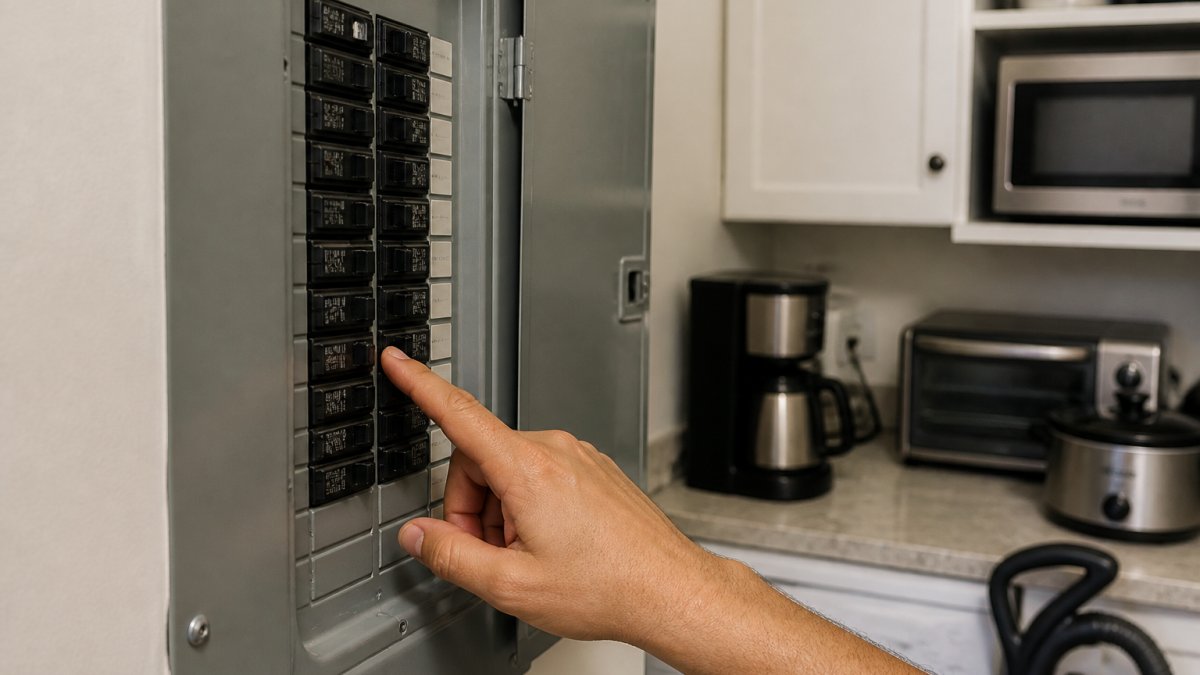
Step 1: Locate your electrical panel. It's usually in a basement, garage, utility room, or outside on the home's exterior. Open the panel door.
Step 2: Identify the tripped breaker. Look for a switch that's in the middle position or fully to the OFF side.
Step 3: Flip the breaker fully to OFF. Push it all the way to the OFF position. You may hear or feel a click.
Step 4: Flip it back to ON. Push it firmly to the ON position. It should click and stay in place.
Step 5: Test the circuit. Plug in a lamp or device.
Safety rules: Never touch the main breaker or large wires. Keep hands dry.
A single reset is normal. A breaker that trips once and holds is usually responding to a temporary overload.
An appliance that repeatedly trips the breaker is failing. It's drawing excessive current or has developed an internal fault. Do not ignore this pattern.
First, unplug the appliance immediately. Reset the breaker. If the breaker holds, the appliance is the problem. Do not plug it back in.
Test the appliance in a different location. If the breaker trips, the appliance is faulty. If not, the original circuit or outlet has a problem.
Check the appliance for visible damage. Look for frayed cords, cracks in the housing, moisture inside, or burning smells.
Age matters. An appliance over 10-15 years old that repeatedly trips the breaker is likely near the end of its life. Motors wear out. Insulation deteriorates. Heating elements fail.
Call an electrician if:
Electric Falls can test your appliances and wiring to pinpoint the exact cause. We help you decide whether to replace the appliance, repair it, or upgrade your electrical system.
Some breaker-trip situations are DIY fixable. Others require professional expertise. Knowing the difference keeps you safe and prevents costly mistakes.
Call an electrician if:
A licensed electrician diagnoses the root cause. They test circuits, inspect wiring, and identify faulty appliances. They recommend permanent solutions: rewiring, panel upgrades, dedicated circuits, or appliance replacement.
Electric Falls serves Southeast Idaho homeowners with over eight years of residential electrical experience. We're licensed and insured, handling panel upgrades, rewiring, circuit additions, and appliance diagnostics to identify and fix breaker-trip problems.
Breaker trips are your home's way of telling you something's wrong. Sometimes it's a simple overload. Sometimes it's a faulty appliance. Sometimes it's damaged wiring that needs immediate attention. The key is recognizing which situation you're facing and taking the right next step. If you're unsure whether your problem is a quick fix or a serious safety issue, contact Electric Falls for a professional assessment.
When multiple high-demand appliances run simultaneously, they draw more current than the circuit can safely handle. Your breaker trips to prevent overheating and fire hazard. This is especially common in older homes where circuits weren't designed for modern appliance power demands. If this happens regularly, you likely have an overloaded circuit that needs attention from a licensed electrician who can assess your electrical load and recommend solutions.
An appliance that keeps tripping the breaker will cause the same circuit to fail every time you use that specific device, regardless of what else is running. An overloaded circuit trips when multiple appliances run together. To test, run the suspect appliance alone on that circuit. If it still trips, the appliance is faulty. If it runs fine alone but trips with other devices, your circuit is overloaded and needs professional evaluation.
First, switch off any appliances on that circuit. Locate your electrical panel and identify the tripped breaker, it will be in the middle position or fully OFF. Move it fully to OFF, then back to ON. If it trips again immediately, stop and contact a licensed electrician. Repeated tripping indicates a serious problem like a short circuit or ground fault that requires professional diagnosis and repair.
A faulty appliance typically trips only its dedicated circuit breaker, not the main breaker. However, a severe short circuit or ground fault within an appliance can potentially trip the main breaker if it draws excessive current. If your main breaker keeps tripping, this is a serious safety concern requiring immediate attention from a licensed electrician to prevent fire hazard and protect your home's electrical system.

What an excellent experience! I highly recommend this company! from first contact, through quoting, modifications to scope, ordering materials, installation and follow through, there was not a single minute that I didn't know exactly what was going on. The communication, product and service were all impeccable. A+

Gerry T.


Dustin came over to our house and helped us hook up a hot tub. His quote was well below others that we had come over and he was super easy to work with. I would recommend electric falls to anyone who needs a great electrician at an affordable cost!

Hailey W.
These guys are awesome. More than fair pricing, punctual and professional! Highly recommend!

Jim C.
Quick response and fixed the problem efficiently. Would use him again with any needs.

Christine P.
We had a great experience with Electric Falls. We had a need to replace an old fuse box with a breaker box. Dustin was quick to respond, was reasonable in his quote, and did exceptional work. We were pleased with his coordination with us and with Idaho Falls Power. He performed the work when he said he would do it and completed the work within the timeframe that was estimated. Overall, we are extremely satisfied with Electric Falls and will be calling on them again for future needs.

Paul M.
I can not say enough good things about these guys. They got to me so quickly, were incredibly nice, and handled my problem right away. 10/10 would recommend

Whitney P.
Dustin is everything you wish for in every small business owner! He went above and beyond right out of the gate by coming by to do my quote in the evening when he was leaving for a long weekend the next morning. He explained everything about the quote. Price was fair for work being done. He and Cameron showed up as promised and did quick, quality work. Highly recommend!

Robert N.
Dustin was professional from bid thru install of our emergency home generator. In the future I'm going to call for a bid to do the electrical install in our unfinished basement. I'm thinking I don't want you to know about him because he will become too busy to help me. But, go ahead and do with this review as you will but I'm keeping his name at the top of my contacts list. :-)

Korky F.
We had Dustin from Electric Falls come out and install the wiring for a hot tub as well as install a whole home surge protector. Dustin was awesome. He was super informative and got us all set up right away. We are so thrilled that we found a great and reliable electrician. His workers were awesome as well. They were very helpful.

Todd R.
Wonderful customer service and very professional yet personable technicians.
Said what they would do and for how much and they did it
Thank you for all your work

Earl L.
Quick and Efficient! Was able to find the problem and get it all taken care of within the same day so we had our power and utilities working properly again.

Abigail J.
We had Electric Falls run some electricity to our newly built shed. It required trenching the yard to bury some of the lines. They did an awesome job! They were right on time and cleaned everything up. The end price was the exact amount quoted! We will be calling on them again!

Steve C.
Dude was the best, mega polite, answered literally every question we possible had. Pricing was fair and straightforward. He came right away and got out power back up.

Alex M.
What a great job! Electric Falls were professional, quick, knowledgeable and kind. It’s was my first project with them and I will have many more to come. They will be my first choice all things electrical from here on out. Keree 💝❤️🙏

Keree A.
Great to work with! Very knowledgeable, great at explaining the issue, and got the job done fast!

Ryan S.
Dustin was at our home this morning to repair several light issues. He was here on time, got the job done quickly and made several helpful suggestions for upgrades in our home as it is over 40 years old. Very professional and knowledgeable. Will use again.

Dennis B.
These folks worked with me on a very short timeline, even did the job on Sunday. Price was explained in detail and was very reasonable. They went above and beyond to take care of me. I would highly recommend them for any of your electrical or generator needs.

AC
Great service and a good recommendation to solve my problem!

Andy E.
Great friendly, professional, and local service. Prompt scheduling and arrived as promised! Diagnosed my electrical problem quickly and resolved the issue for a fair price.

David S.
Electric falls responded quickly and they worked with me to get my house in much better shape. Dustin was very knowledgeable, the cost for the services were reasonable and he finished everything very quickly.

Katrina S.
Great Service!

Richard J.
Dustin and Cameron came to look and see what they needed to hook up our garbage disposal, and within 30 minutes they had put in a new outlet and hooked up the disposal to a switch. Very kind and respectful gentleman who make electrical problems a breeze for a fair price.

Marissa H.
Super fast and very friendly!

Mackenzie J.
They are very good to work with. Always called to let me know exactly when they were coming. Came on time and finished earlier than expected.

Laura M.
Dustin was recommended to me and within a few hours of calling him he was out to my house in Shelley and fixed the issue. The cost was fair and Dustin was so kind and professional. He was able to work with my schedule and even let me know when he was on his way. Highly recommend if you are in need of an electrician.

Jenna H.
Highly recommend these guys. Cameron and Dustin were fast and efficient and answered all our questions we installed a home surge protector because recently the power went out and blew our furnace.

McKinzi M.
This company is amazing! Very professional and great to work with. I would highly recommend them to anyone.

Justin R.
Very personable service. We had a couple of light fixtures changed out to ceiling fans, had a fan installed in a bathroom and a few other light switch modifications done and the work was very good! And they cleaned up any mess well! Would recommend using them.

Susan M.
Dustin was great to work with. Their pricing was fair, they were great to communicate with, and they were prompt to get the work done with a schedule that worked great for me.

Kelly S.
Highly recommend Electric falls, they came out next day, gave us a couple of options with what works in our price range, and got us squared away extremely fast. We will definetly be calling them again very soon for some future needs. Thank you for everything.

Casey D.
Communicated very well. Friendly and easy going. He worked with my schedule. Lead time was only a couple of weeks. I look forward to using his service on the next step of my project.

Andrew M.
Dustin solved our electrical problems with one call. His response was quick and the cost was reasonable. We're very satisfied.

Frank W.
Since I used to DO this work and medically can’t do it myself, it gives me great pleasure to say that ElectricFalls.com will give you the same professional, ethical and proper service to you when you need electrical work done that they gave me. And will give me in my next project.No job too big or too small, all you need to do is ASK.

Carol B.
We had an electrical issue with a heater in our downstairs toy room. We called Dustin Thurman of Electric Falls, and he came out that same day; he was able to diagnose the problem and fix it quickly and completely. He explained what he thought was probably the problem, and it turned out to be exactly that. He was courteous and professional, explained everything to us, including how to avoid the problem in the future, and we would not hesitate to call Dustin again for any electrical problem. We would highly recommend him to friends and family.

Gail I.
This was a great experience! We called around and didn't get call backs from anyone. We needed a EV charger installed. Electrical Falls answered immediately made it out to our home for a quote within an hour. We agreed on a honest and fair price. Install was done properly and within a time frame that worked perfect for us! Thank you Electric falls you will be our first call in the future and will be highly recommended!

Marcelino S.
Electric Falls was prior in getting back to me and did a quick great job with my electrical needs. Very friendly and really well priced!

Zoey C.
Excellent work and cleans up after the work as well! Plus, Dustin was on time, courteous and friendly. I would have them do more work for me anytime I need it.

Mary Ann C.
Dustin with Electric Falls was absolutely amazing to work with. He answered all our electrical questions while buying a home, and then helped us fix them after closing. His flexibility and kindness made him super easy to work with. I would recommend him for any job, and we will be utilizing him for future projects on our new home. Such a great experience!!
.svg)
Danielle S.
Dustin has helped us with several electrical jobs and knocks it out of the park every time. He is efficient, professional, friendly, and cleans up after he's done – not many do this these days! If and when we need more work done we will never hesitate to call Dustin at Electric Falls. Thanks

Madeline
Prompt, efficient, knowledgeable, tidy, honest, friendly, reasonable rates. After all the electricians we have tried, Dustin at Electric Falls is by far the best in every way. I will never call anyone else ever again for our electric needs.
.svg)
Debbie H.
Dustin is very responsive, he's a great communicator, and he is reasonably priced. I have hired him for four separate jobs in the last four months, and I plan to hire him for more jobs in the future.

Russell P.
Dustin is great to work with and very fast. He squeezed me in very quickly and worked quickly and efficiently until it was done. Also reasonably priced. I would highly recommend Electric Falls
.png)
Rachael J.
Dustin jumped in and took amazing care of us on short notice! He was able to squeeze us in and took care of business quickly and efficiently without overcharging. We are so appreciative of the work he did! If you ever need a great electrician to help you with your home, whether a new build or a place you’ve been in for years, Dustin is your guy! Give him a call; you won’t be disappointed!!!
.svg)
Jarod P.
Dustin has great customer service and is a knowledgeable electrician. He fixed our wall heater, installed a ceiling fan, and corrected some crossed wires on a two-way switch. He also checked out some outlets I had concerns with. He was friendly and professional. I highly recommend.

Amanda G.
Electric Falls is professional,friendly, and fair priced! We will definitely be using them for all our electrical needs in the future.
.svg)
Chandler L.
Great company to work with for any electrical needs you have. On time, professional, fair pricing and very knowledgeable. We will definitely use them again!!
.svg)
Heather K.
If you're looking for a competent, courteous, and thorough electrician, look no further. Dustin definitely exceeded all of our expectations!
.png)
Mike G.
Very knowledgeable and professional. Would recommend to others.
.png)
Trena T.
Dustin was very pleasant and did an excellent job
.svg)
Robert T.
Dustin does excellent work!! Quick, efficient. Very flexible!!
.svg)
Lance L.
Very knowledgeable and professional service. I will be using him again and will definitely recommend him to others.
.png)
Donna T.
Dustin is professional, timely, and friendly.
.svg)
DJ D.
They were prompt and did a good job.
.svg)
Wood F.
Outstanding service, not waiting, answers inquiries fast and to the point.
.png)
Rubi F.
Very happy with their work.
.png)
Glenn W.
We lost all Power at the last outage. It fried our panel and breakers. We also lost a thermostat. He replaced all of that plus put a surge protector so we wouldn't have that problem again. He was very professional and explained things very well along with price before doing anything. I would definitely use them again for electrical problems. I trust them and so can you.
.svg)
Bonnie M.
Thank you!
Positive Quality, Professionalism
.png)
Cody F.
Fan installation, Light fixture repair, Electrical outlet & switch installation
.png)
Darin T.

© Electric Falls. All Rights Reserved.
Welcome to Electric Falls, where our commitment to excellence in electrical services has been illuminating the Southeast Idaho community for several years.


.svg)








.png)
.png)
.png)
.png)