Last Updated: November 12, 2026
Quick Summary
A warm outlet is a warning sign that should not be ignored. Stop using it right away, unplug everything, and check whether it stays warm with nothing plugged in. If it does, shut off its breaker if you can do so safely and call a licensed electrician to inspect the warm outlet.
Is your outlet warm to the touch?Electric Falls inspects warm outlets and circuits across Southeast Idaho.Schedule Your Outlet Inspection
A warm electrical outlet is a warning sign, and you should take it seriously.
Here is the simple answer. An outlet should stay close to room temperature. Heat means electricity is running into resistance somewhere, and resistance creates heat.
Think of it this way:
If you are not sure which category you are in, treat the outlet as a problem until you know more. Stop using it, and move on to the next sections.
An outlet that feels warm with nothing plugged in is one of the more serious signs.
Common causes include:
Many homeowners assume the outlet is fine because nothing is plugged in. That is a common mistake. Heat can build up slowly, so the outlet may feel fine at one moment and warm the next.
Turn off the breaker for that outlet if you can do so safely. Then call a licensed electrician to inspect it.
Some signs mean you should act right away. Do not wait for the problem to get worse.

Look for these warning signs:
If you see any of these, stop using the outlet immediately. Shut off the breaker and avoid plugging anything else into it.
For urgent electrical help in Idaho Falls, Rexburg, Rigby, or Ammon, reach out to our emergency electrical services. A faulty outlet is not a problem to test on your own.
Not every warm feeling comes from the outlet itself. Sometimes the heat comes from what is plugged in.
Warm device: The heat comes from the appliance.
Warm plug: The plug feels hot while the outlet face stays cool.
Warm outlet: The faceplate itself is warm, even when no device is plugged in or the device is cool.
A simple test:
If the outlet still feels warm, the problem is in the wall.
Your first job is to make the outlet safe. Your second job is to find the cause. Only the first part is safe for most homeowners, and the right first move depends on what you are seeing and smelling.
Use this flow to decide how urgently to act. It is not a repair guide; it is a way to avoid making a bad situation worse.
Unplug all devices and put a piece of tape over the receptacle or a note on the faceplate so no one else uses it. Do not cover the outlet with furniture or block access to it; you want it visible and avoided.
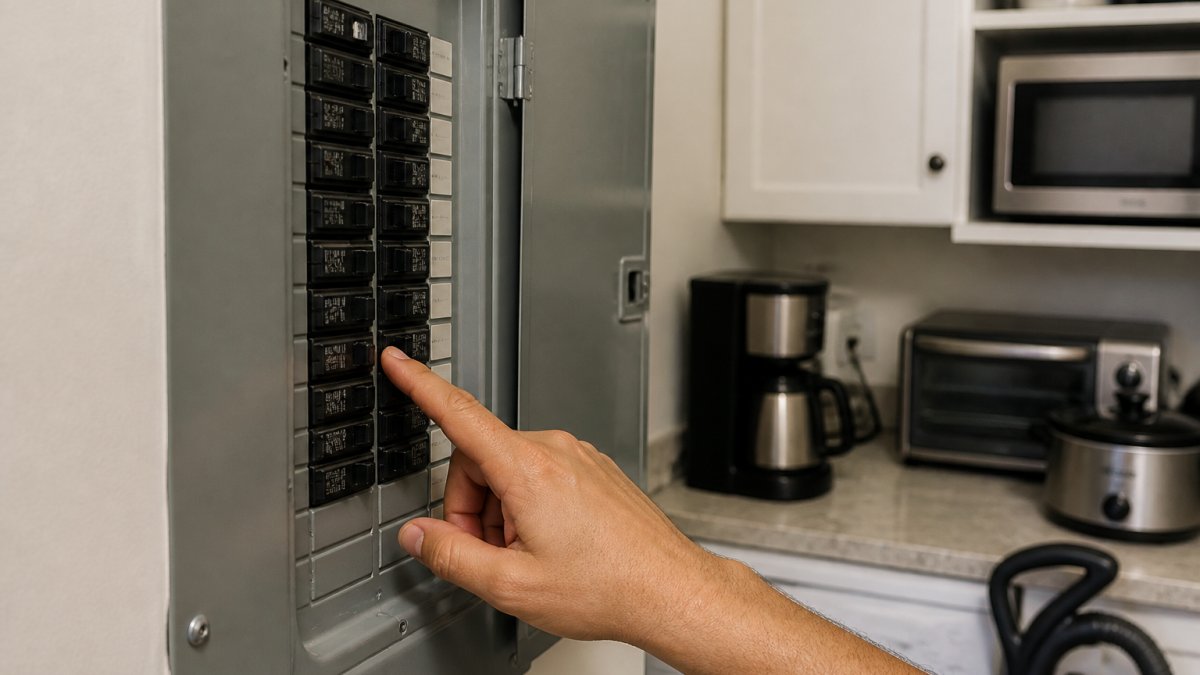
Shutting off the correct breaker is the single most useful thing a homeowner can do, but guessing at the panel is not safe. A few practical rules:
Watch out: a breaker that trips again immediately after you reset it is telling you the circuit has a fault. Repeatedly resetting it can worsen heat damage inside the wall.
Overloaded circuits are a frequent cause of heat. Move high-draw devices such as space heaters, portable air conditioners, microwaves, and vacuums to a different circuit, and avoid running several heavy appliances on the same circuit at once. Extension cords and power strips are for temporary use, not as permanent wiring for high-draw appliances.
Do not open the outlet box, tighten terminal screws, or replace the outlet yourself unless you are trained and permitted to do so. A loose connection can look simple, but a poor reconnection can create a high-resistance joint that heats up and becomes a fire risk. Do not use tape, wire nuts, or makeshift fixes to cover the problem; these can hide heat without solving it.
A GFCI outlet is the kind with "test" and "reset" buttons, often found in kitchens, bathrooms, and outdoor areas. These outlets are designed to cut power when they sense a ground fault.
Possible causes include:
Press the "test" button, then "reset," and watch how the outlet behaves. If it trips often, will not reset, or stays warm, stop using it and have it checked.
A warm outlet needs a proper inspection, not a quick guess. Knowing what the visit involves helps you prepare and helps the electrician work faster.
A licensed electrician will typically start by asking what you noticed and when. You can review the full range of electrical repair and installation services we offer for residential homes before booking a visit. From there, a common inspection sequence looks like this:
Write down a short log before the electrician arrives:
Clear access to the outlet and the electrical panel. Move furniture, and make sure children and pets are kept away from the work area.
If the warm outlet is in a child's room or a baby-proofed area, treat the plug covers as a safety layer, not a fix.
Electric Falls is a licensed and insured electrical contractor serving homeowners in Southeast Idaho, and you can request a quote to schedule an inspection of the outlet, the circuit, and the panel.
Warm outlets are a warning, and the sooner you act, the safer your home stays. Electric Falls is ready to help you find the cause and fix it right the first time.
A slightly warm outlet while a device is charging or running can be normal, but an outlet should not feel hot. Warmth from a heavy-draw appliance such as a space heater or vacuum may be expected for a short time. If the outlet stays warm after the device is unplugged or cools down, or if it feels hot to the touch, treat it as a warning sign. Unplug everything from that outlet, stop using it, and have a licensed electrician check the connections and circuit.
Yes. A loose or failing connection creates electrical resistance, which produces heat. Over time that heat can damage insulation and surrounding materials, and it can lead to arcing or sparking. Burning smells, discoloration around the faceplate, buzzing, or flickering lights are all signs that the outlet needs professional attention right away. Do not wait for the problem to resolve on its own.
An outlet that is warm with nothing connected usually points to wiring rather than a device. Loose wire connections at the terminals, a damaged internal contact, or a shared circuit carrying heavy load from other outlets can all transfer heat to the receptacle. Because the cause is inside the wall, the outlet should be inspected by a licensed electrician, who can check connections and identify the correct circuit breaker.
A hot plug is a concern. Heat at the plug often means the device is drawing more current than the cord or outlet can handle comfortably, or that the plug prongs are making a loose contact. Unplug the device, let it cool, and inspect the cord and plug for damage or discoloration. If the outlet itself is warm or the plug gets hot again with a different device, stop using that outlet and call an electrician.

What an excellent experience! I highly recommend this company! from first contact, through quoting, modifications to scope, ordering materials, installation and follow through, there was not a single minute that I didn't know exactly what was going on. The communication, product and service were all impeccable. A+

Gerry T.


Dustin came over to our house and helped us hook up a hot tub. His quote was well below others that we had come over and he was super easy to work with. I would recommend electric falls to anyone who needs a great electrician at an affordable cost!

Hailey W.
These guys are awesome. More than fair pricing, punctual and professional! Highly recommend!

Jim C.
Quick response and fixed the problem efficiently. Would use him again with any needs.

Christine P.
We had a great experience with Electric Falls. We had a need to replace an old fuse box with a breaker box. Dustin was quick to respond, was reasonable in his quote, and did exceptional work. We were pleased with his coordination with us and with Idaho Falls Power. He performed the work when he said he would do it and completed the work within the timeframe that was estimated. Overall, we are extremely satisfied with Electric Falls and will be calling on them again for future needs.

Paul M.
I can not say enough good things about these guys. They got to me so quickly, were incredibly nice, and handled my problem right away. 10/10 would recommend

Whitney P.
Dustin is everything you wish for in every small business owner! He went above and beyond right out of the gate by coming by to do my quote in the evening when he was leaving for a long weekend the next morning. He explained everything about the quote. Price was fair for work being done. He and Cameron showed up as promised and did quick, quality work. Highly recommend!

Robert N.
Dustin was professional from bid thru install of our emergency home generator. In the future I'm going to call for a bid to do the electrical install in our unfinished basement. I'm thinking I don't want you to know about him because he will become too busy to help me. But, go ahead and do with this review as you will but I'm keeping his name at the top of my contacts list. :-)

Korky F.
We had Dustin from Electric Falls come out and install the wiring for a hot tub as well as install a whole home surge protector. Dustin was awesome. He was super informative and got us all set up right away. We are so thrilled that we found a great and reliable electrician. His workers were awesome as well. They were very helpful.

Todd R.
Wonderful customer service and very professional yet personable technicians.
Said what they would do and for how much and they did it
Thank you for all your work

Earl L.
Quick and Efficient! Was able to find the problem and get it all taken care of within the same day so we had our power and utilities working properly again.

Abigail J.
We had Electric Falls run some electricity to our newly built shed. It required trenching the yard to bury some of the lines. They did an awesome job! They were right on time and cleaned everything up. The end price was the exact amount quoted! We will be calling on them again!

Steve C.
Dude was the best, mega polite, answered literally every question we possible had. Pricing was fair and straightforward. He came right away and got out power back up.

Alex M.
What a great job! Electric Falls were professional, quick, knowledgeable and kind. It’s was my first project with them and I will have many more to come. They will be my first choice all things electrical from here on out. Keree 💝❤️🙏

Keree A.
Great to work with! Very knowledgeable, great at explaining the issue, and got the job done fast!

Ryan S.
Dustin was at our home this morning to repair several light issues. He was here on time, got the job done quickly and made several helpful suggestions for upgrades in our home as it is over 40 years old. Very professional and knowledgeable. Will use again.

Dennis B.
These folks worked with me on a very short timeline, even did the job on Sunday. Price was explained in detail and was very reasonable. They went above and beyond to take care of me. I would highly recommend them for any of your electrical or generator needs.

AC
Great service and a good recommendation to solve my problem!

Andy E.
Great friendly, professional, and local service. Prompt scheduling and arrived as promised! Diagnosed my electrical problem quickly and resolved the issue for a fair price.

David S.
Electric falls responded quickly and they worked with me to get my house in much better shape. Dustin was very knowledgeable, the cost for the services were reasonable and he finished everything very quickly.

Katrina S.
Great Service!

Richard J.
Dustin and Cameron came to look and see what they needed to hook up our garbage disposal, and within 30 minutes they had put in a new outlet and hooked up the disposal to a switch. Very kind and respectful gentleman who make electrical problems a breeze for a fair price.

Marissa H.
Super fast and very friendly!

Mackenzie J.
They are very good to work with. Always called to let me know exactly when they were coming. Came on time and finished earlier than expected.

Laura M.
Dustin was recommended to me and within a few hours of calling him he was out to my house in Shelley and fixed the issue. The cost was fair and Dustin was so kind and professional. He was able to work with my schedule and even let me know when he was on his way. Highly recommend if you are in need of an electrician.

Jenna H.
Highly recommend these guys. Cameron and Dustin were fast and efficient and answered all our questions we installed a home surge protector because recently the power went out and blew our furnace.

McKinzi M.
This company is amazing! Very professional and great to work with. I would highly recommend them to anyone.

Justin R.
Very personable service. We had a couple of light fixtures changed out to ceiling fans, had a fan installed in a bathroom and a few other light switch modifications done and the work was very good! And they cleaned up any mess well! Would recommend using them.

Susan M.
Dustin was great to work with. Their pricing was fair, they were great to communicate with, and they were prompt to get the work done with a schedule that worked great for me.

Kelly S.
Highly recommend Electric falls, they came out next day, gave us a couple of options with what works in our price range, and got us squared away extremely fast. We will definetly be calling them again very soon for some future needs. Thank you for everything.

Casey D.
Communicated very well. Friendly and easy going. He worked with my schedule. Lead time was only a couple of weeks. I look forward to using his service on the next step of my project.

Andrew M.
Dustin solved our electrical problems with one call. His response was quick and the cost was reasonable. We're very satisfied.

Frank W.
Since I used to DO this work and medically can’t do it myself, it gives me great pleasure to say that ElectricFalls.com will give you the same professional, ethical and proper service to you when you need electrical work done that they gave me. And will give me in my next project.No job too big or too small, all you need to do is ASK.

Carol B.
We had an electrical issue with a heater in our downstairs toy room. We called Dustin Thurman of Electric Falls, and he came out that same day; he was able to diagnose the problem and fix it quickly and completely. He explained what he thought was probably the problem, and it turned out to be exactly that. He was courteous and professional, explained everything to us, including how to avoid the problem in the future, and we would not hesitate to call Dustin again for any electrical problem. We would highly recommend him to friends and family.

Gail I.
This was a great experience! We called around and didn't get call backs from anyone. We needed a EV charger installed. Electrical Falls answered immediately made it out to our home for a quote within an hour. We agreed on a honest and fair price. Install was done properly and within a time frame that worked perfect for us! Thank you Electric falls you will be our first call in the future and will be highly recommended!

Marcelino S.
Electric Falls was prior in getting back to me and did a quick great job with my electrical needs. Very friendly and really well priced!

Zoey C.
Excellent work and cleans up after the work as well! Plus, Dustin was on time, courteous and friendly. I would have them do more work for me anytime I need it.

Mary Ann C.
Dustin with Electric Falls was absolutely amazing to work with. He answered all our electrical questions while buying a home, and then helped us fix them after closing. His flexibility and kindness made him super easy to work with. I would recommend him for any job, and we will be utilizing him for future projects on our new home. Such a great experience!!

Danielle S.
Dustin has helped us with several electrical jobs and knocks it out of the park every time. He is efficient, professional, friendly, and cleans up after he's done – not many do this these days! If and when we need more work done we will never hesitate to call Dustin at Electric Falls. Thanks

Madeline
Prompt, efficient, knowledgeable, tidy, honest, friendly, reasonable rates. After all the electricians we have tried, Dustin at Electric Falls is by far the best in every way. I will never call anyone else ever again for our electric needs.

Debbie H.
Dustin is very responsive, he's a great communicator, and he is reasonably priced. I have hired him for four separate jobs in the last four months, and I plan to hire him for more jobs in the future.

Russell P.
Dustin is great to work with and very fast. He squeezed me in very quickly and worked quickly and efficiently until it was done. Also reasonably priced. I would highly recommend Electric Falls

Rachael J.
Dustin jumped in and took amazing care of us on short notice! He was able to squeeze us in and took care of business quickly and efficiently without overcharging. We are so appreciative of the work he did! If you ever need a great electrician to help you with your home, whether a new build or a place you’ve been in for years, Dustin is your guy! Give him a call; you won’t be disappointed!!!

Jarod P.
Dustin has great customer service and is a knowledgeable electrician. He fixed our wall heater, installed a ceiling fan, and corrected some crossed wires on a two-way switch. He also checked out some outlets I had concerns with. He was friendly and professional. I highly recommend.

Amanda G.
Electric Falls is professional,friendly, and fair priced! We will definitely be using them for all our electrical needs in the future.

Chandler L.
Great company to work with for any electrical needs you have. On time, professional, fair pricing and very knowledgeable. We will definitely use them again!!

Heather K.
If you're looking for a competent, courteous, and thorough electrician, look no further. Dustin definitely exceeded all of our expectations!

Mike G.
Very knowledgeable and professional. Would recommend to others.

Trena T.
Dustin was very pleasant and did an excellent job

Robert T.
Dustin does excellent work!! Quick, efficient. Very flexible!!

Lance L.
Very knowledgeable and professional service. I will be using him again and will definitely recommend him to others.

Donna T.
Dustin is professional, timely, and friendly.

DJ D.
They were prompt and did a good job.

Wood F.
Outstanding service, not waiting, answers inquiries fast and to the point.

Rubi F.
Very happy with their work.

Glenn W.
We lost all Power at the last outage. It fried our panel and breakers. We also lost a thermostat. He replaced all of that plus put a surge protector so we wouldn't have that problem again. He was very professional and explained things very well along with price before doing anything. I would definitely use them again for electrical problems. I trust them and so can you.

Bonnie M.
Thank you!
Positive Quality, Professionalism

Cody F.
Fan installation, Light fixture repair, Electrical outlet & switch installation

Darin T.

© Electric Falls. All Rights Reserved.
Welcome to Electric Falls, where our commitment to excellence in electrical services has been illuminating the Southeast Idaho community for several years.


 Add electricfalls.com as a preferred source on Google →